Key points
- Frost can lift shallow control points and hubs, so benchmarks need checking through the winter.
- Paint does not hold on snow. Winter marks go on lath, pins and nails.
- Short days and long drives mean winter visits need tighter planning than summer ones.
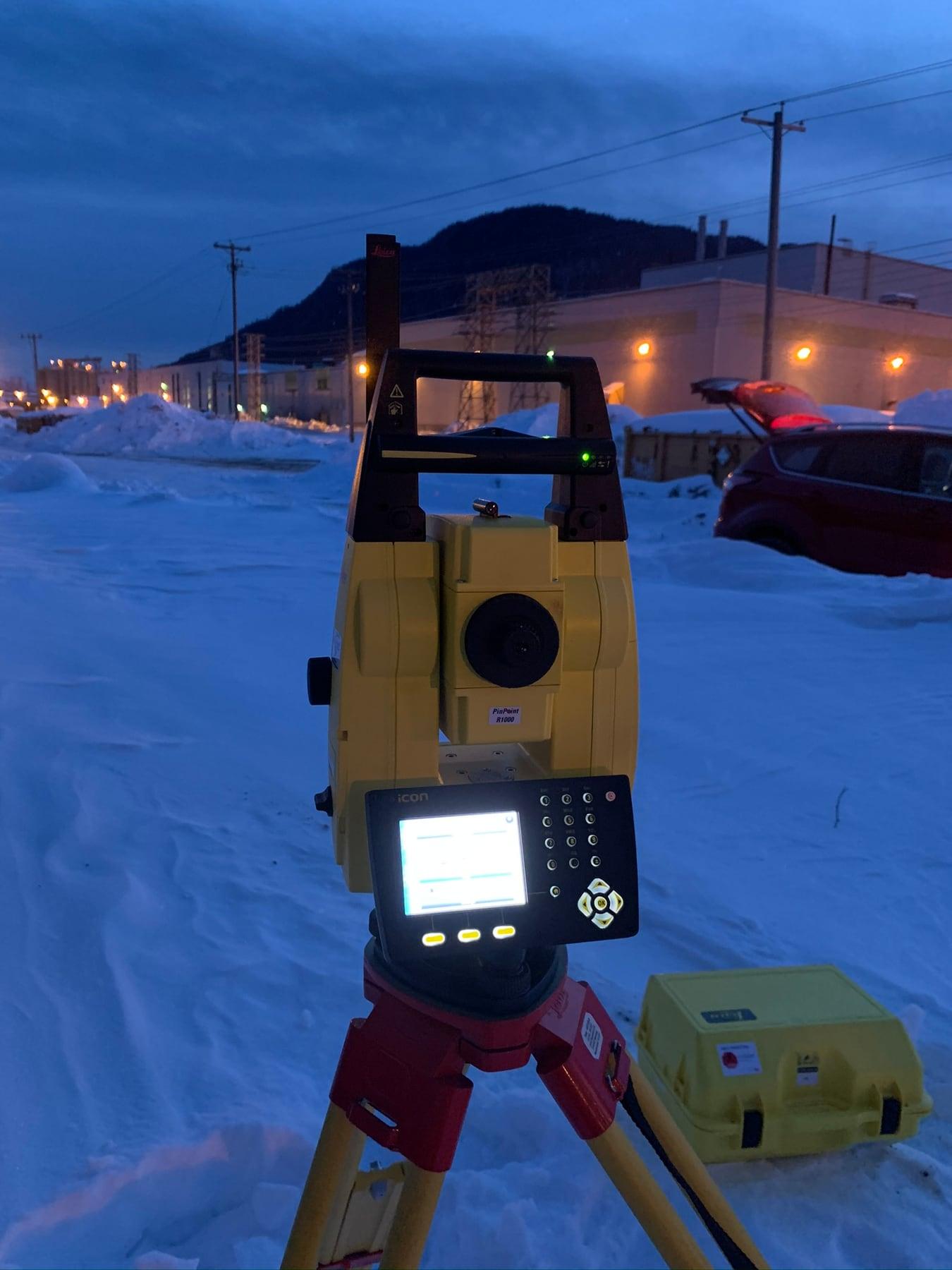
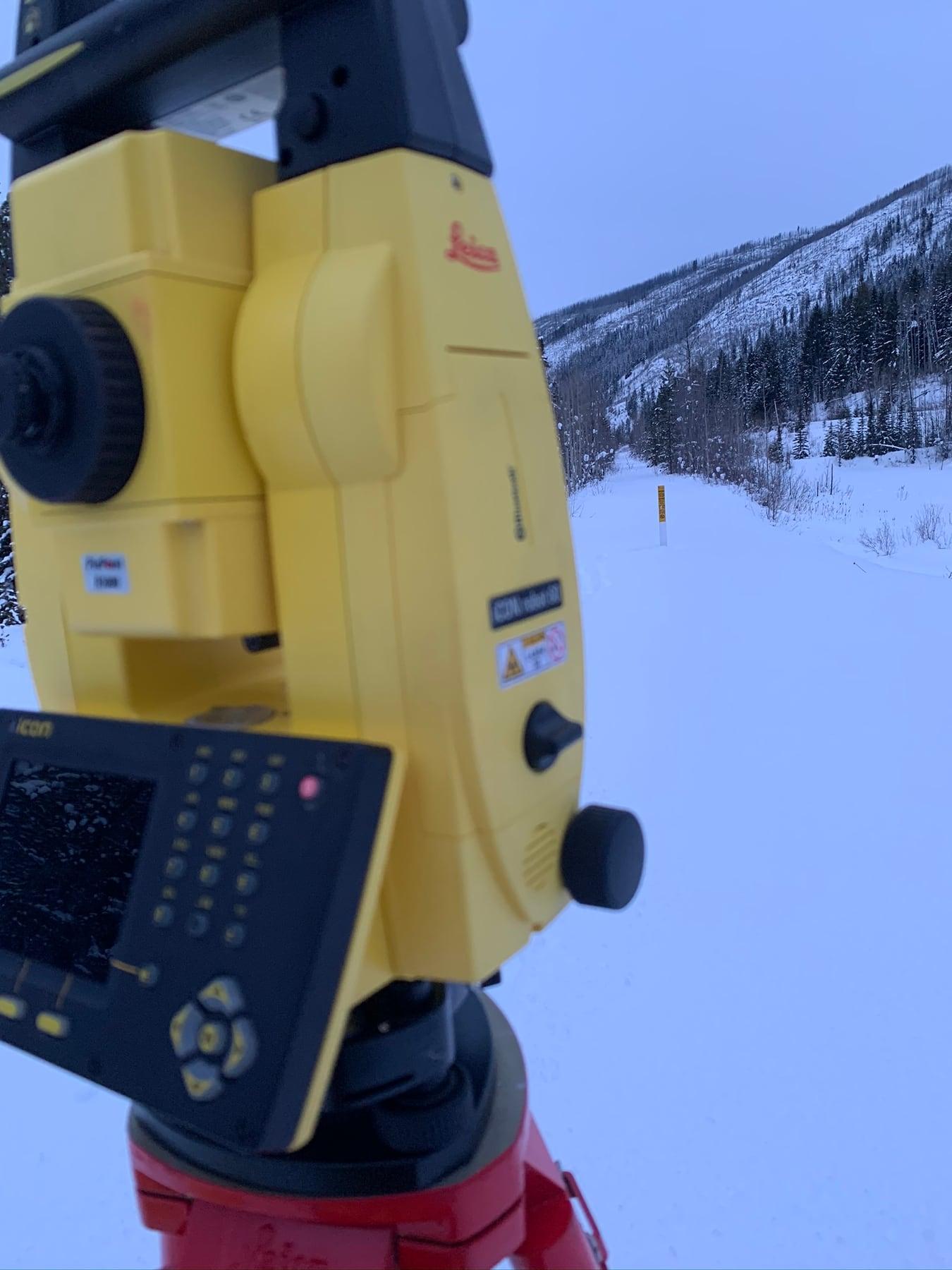
Construction surveying carries on through an Alberta winter, and for piling in soft ground, winter is often the busy season. What changes is how much checking is needed. Frost moves control points, cold drains batteries, snow hides marks and daylight is short. None of that stops the work, but each needs to be planned for.
Here is what a superintendent should know about getting reliable layout between freeze-up and breakup.
Does frost move survey control points?
Yes. Frost heave is the main winter risk to survey control. As moisture in the soil freezes, the ground can lift, and a shallow point lifts with it. Clay and silt soils with water available are the most affected. A short iron bar or a wooden hub can rise noticeably over a winter and may not settle back to the same place in spring. The movement is mostly vertical, but points can tilt and shift sideways as well.
Points that are least affected are those set on something founded below the frost: an existing building foundation, a pile, a deep-set rod, or a concrete structure that has been in place for years. Where the site allows, we place at least some benchmarks on structures like these when site control is first set, so there is a stable reference to check the others against.
How often should benchmarks be checked in winter?
Every visit. The crew checks into more than one benchmark and more than one control point at each setup and compares what it measures to the published values. A single benchmark cannot show that it has moved. Two that disagree show there is a problem, and a third shows which one. If the site has only shallow points, a level run between them at freeze-up and again partway through winter shows what is moving. The same checks are repeated at spring thaw, when points can settle and soft ground lets them lean.
Hubs and grade stakes set in the fall are subject to the same heave. If grade stakes have sat through a hard freeze, have the elevations checked before you build to them.
How does cold affect survey instruments?
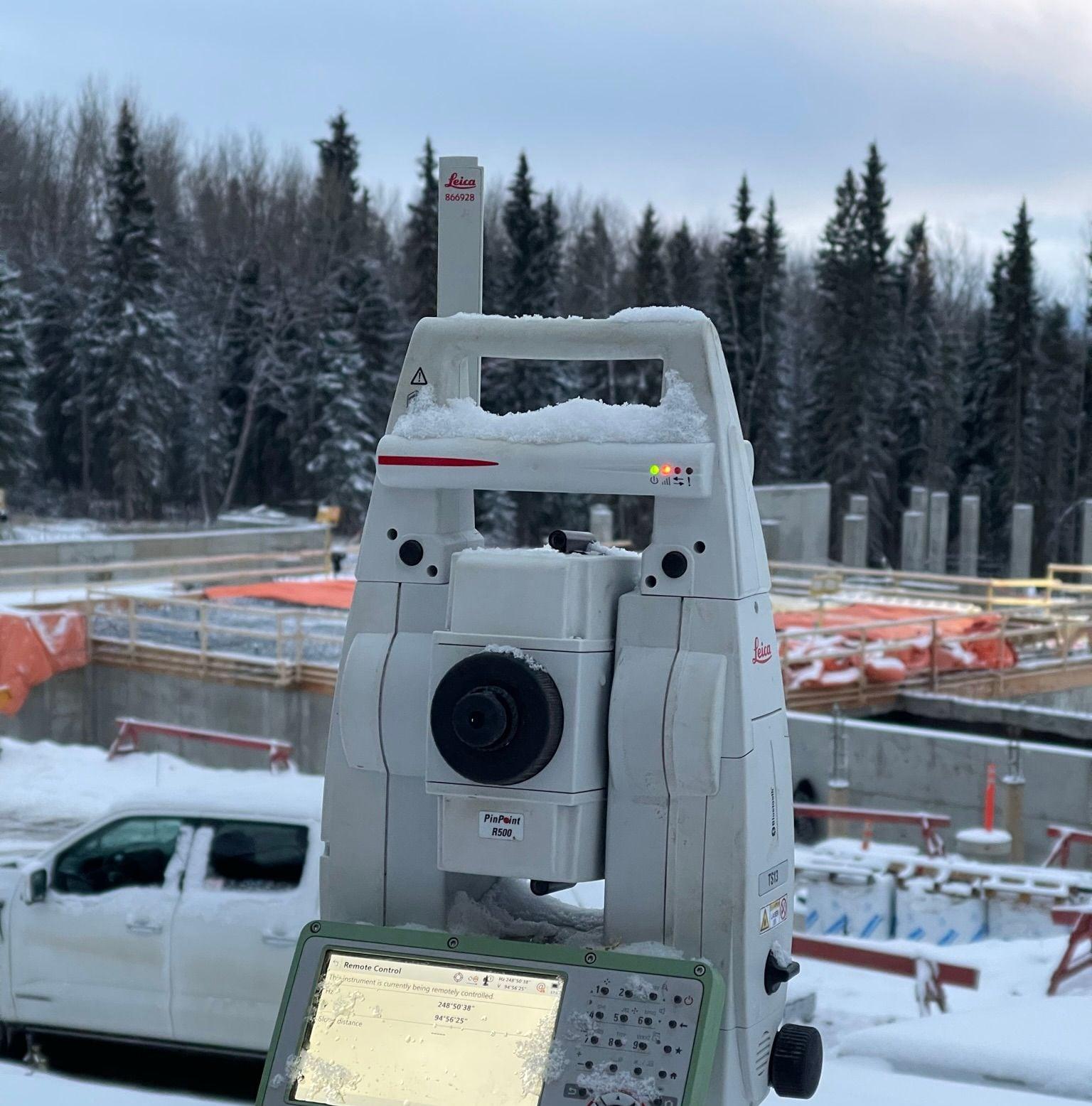
- Batteries lose capacity in the cold. Crews carry spares and keep them warm until they are needed.
- Displays and touch screens slow down, and cables and plastic parts become brittle.
- Moving an instrument from a warm truck into cold air, or back again, causes condensation on and inside the optics. It needs time to adjust, and it is warmed up gradually in its case at the end of the day.
- Air temperature affects electronic distance measurement. The instrument applies a correction for temperature and pressure, and it has to be set for the day. Left at a summer value, the error can reach a few millimetres over a hundred metres.
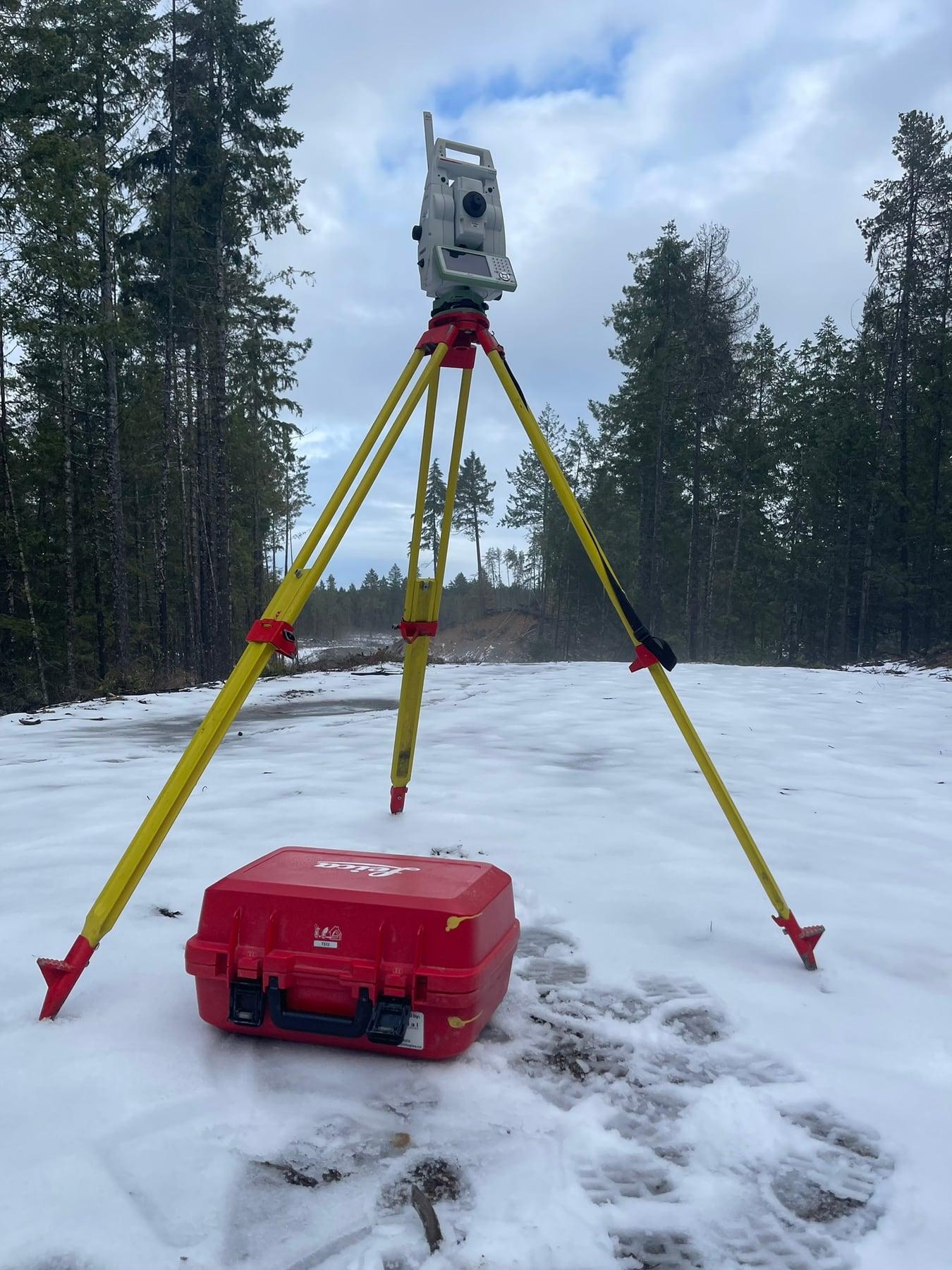
- Tripod feet set on frozen ground can sink as the sun or a nearby heater thaws the surface, so the instrument's level is watched and backsight checks are repeated through the setup.
- Manufacturers publish a minimum operating temperature for each instrument. Below it, work stops.
How do you mark layout in snow?
Paint on snow lasts until the next snowfall or the next pass of a loader. Winter marks need to be physical: lath with the information written on the face, steel pins, nails with bright whiskers or flagging, and offsets set on something that will still be there next week. Frozen ground is hard on wooden hubs, so a pilot hole is often made with a steel pin or a drill first.
It helps a great deal if the work area is cleared before the crew arrives. Layout on a scraped surface is faster and the marks are easier to find afterward. Ground surveys under snow are a different matter. A topographic survey or volume survey measures the surface the rod or the drone can reach, so snow and ice in an excavation need to be cleared or the survey delayed. See drone and LiDAR surveys on construction sites for more on that limit.
Why is winter the piling season in the north?
Much of northern Alberta is muskeg and soft ground that will not carry a piling rig in summer. Once it freezes, equipment can travel, and winter access roads open areas that are closed the rest of the year. Pile programs on those sites are scheduled for the frozen months, and the survey crew is there with them, staking ahead of the rig and measuring piles behind it. The method is described in pile layout and as-built surveys for oil sands projects.
How do short days and winter roads affect scheduling?
In late December, Edmonton gets about seven and a half hours of daylight, and sites farther north get less. Robotic instruments work in the dark, but finding marks, reading stakes and moving safely around an active site are all slower under lights. A scope that fills one summer day may take a day and a half in midwinter.
Travel takes longer too. Highways 63, 43, 28 and 35 carry heavy industrial traffic and can be slow or closed in bad weather. Crews carry winter survival gear, check road reports before leaving, and do not drive tired to make up time. Extreme cold can also stop outdoor work under a site's own safety rules, whatever the survey crew is able to do.
How should you plan a winter survey visit?
- Book earlier than you would in summer, and allow a weather day on remote jobs.
- Clear snow from the work area and from control points before the crew arrives.
- Group the scope so one trip covers as much as possible.
- Ask for a benchmark check at the start of every visit, and expect it to take a little time.
- Provide a warm place for batteries and data collectors if the crew is on site for several days.
- Protect control points from snow clearing. Mark them with tall lath so the loader operator can see them.
- Send drawings ahead so calculations are finished before the crew leaves, and daylight is spent on layout.
For winter layout or pile surveys anywhere in Alberta, talk to us at (587) 714-2362 or send your dates through the quote form.