Key points
- The writing on the stake governs. Flagging and paint colours are not standardized between companies.
- A cut or fill is measured from a stated reference, usually the top of the hub or a line on the lath.
- If a stake has been hit or you cannot read it, stop and ask before you build from it.
A construction survey stake tells you three things: what it refers to, how far away that thing is, and how far up or down to design grade. The feature is named on the stake, the horizontal distance is the offset, and the vertical distance is written as a cut or a fill. Read all three before you dig or form.
The writing on the stake governs. Flagging and paint colours are not standardized between survey companies, so a colour that meant curb on your last job may mean storm sewer on this one. Abbreviations vary too. If the writing is unclear, ask the surveyor.
What is the difference between a hub and a lath?
A hub is a short, square wooden stake driven nearly flush with the ground, often with a tack or nail in the top. The hub is the measured point. Its position is exact, and when grades are given, the elevation usually refers to the top of the hub.
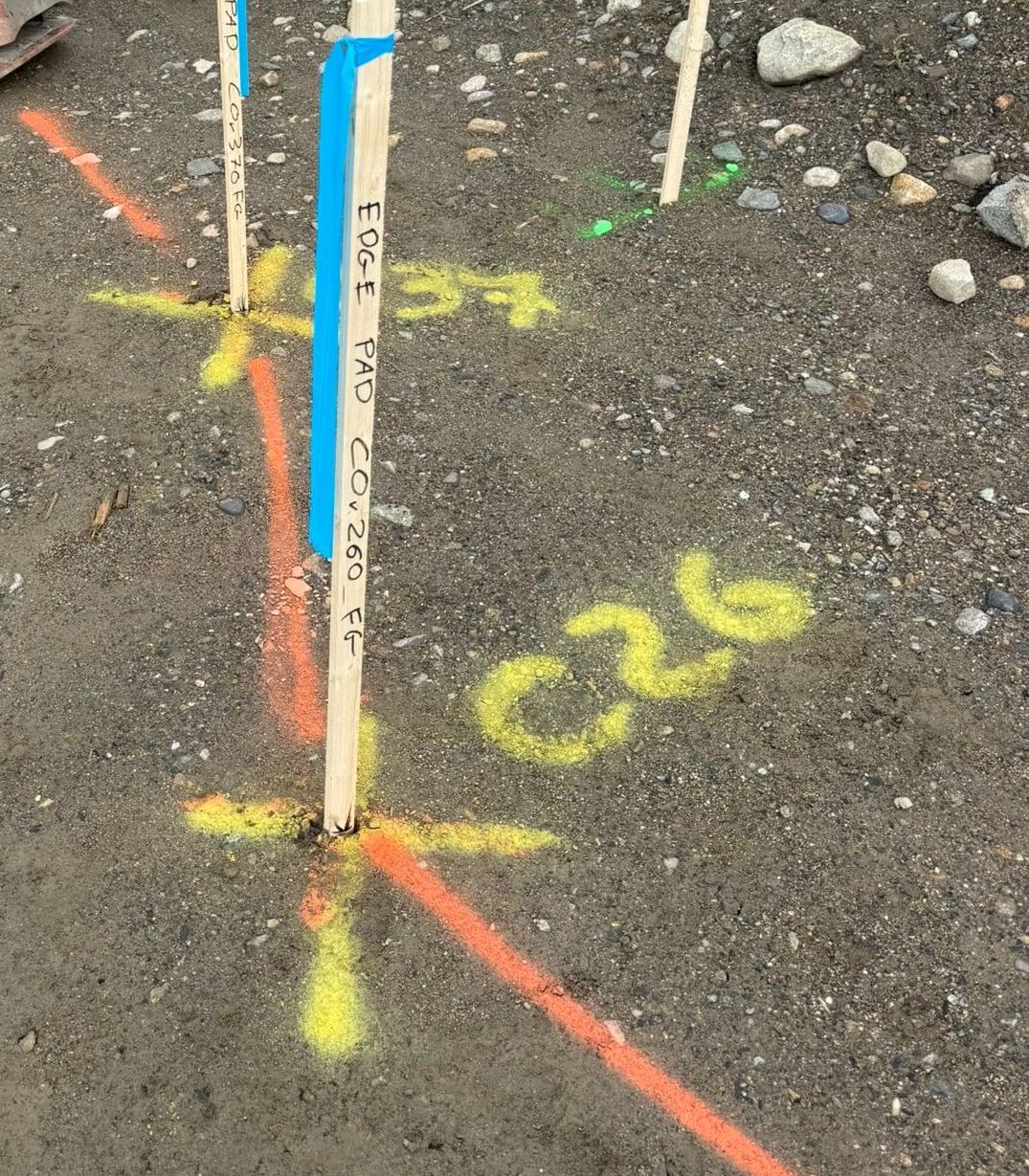
A lath is the tall, thin stake with the writing on it. It stands beside the hub so you can find it and read what it means. A lath used this way is often called a guard stake or witness stake. Do not measure from the lath unless it says to. On rough grading, a lath may be used alone, with a horizontal line or crow's foot drawn on it as the grade reference. On concrete and asphalt, a nail, a scribe mark or a paint mark takes the place of the hub.
What does the offset on a stake mean?
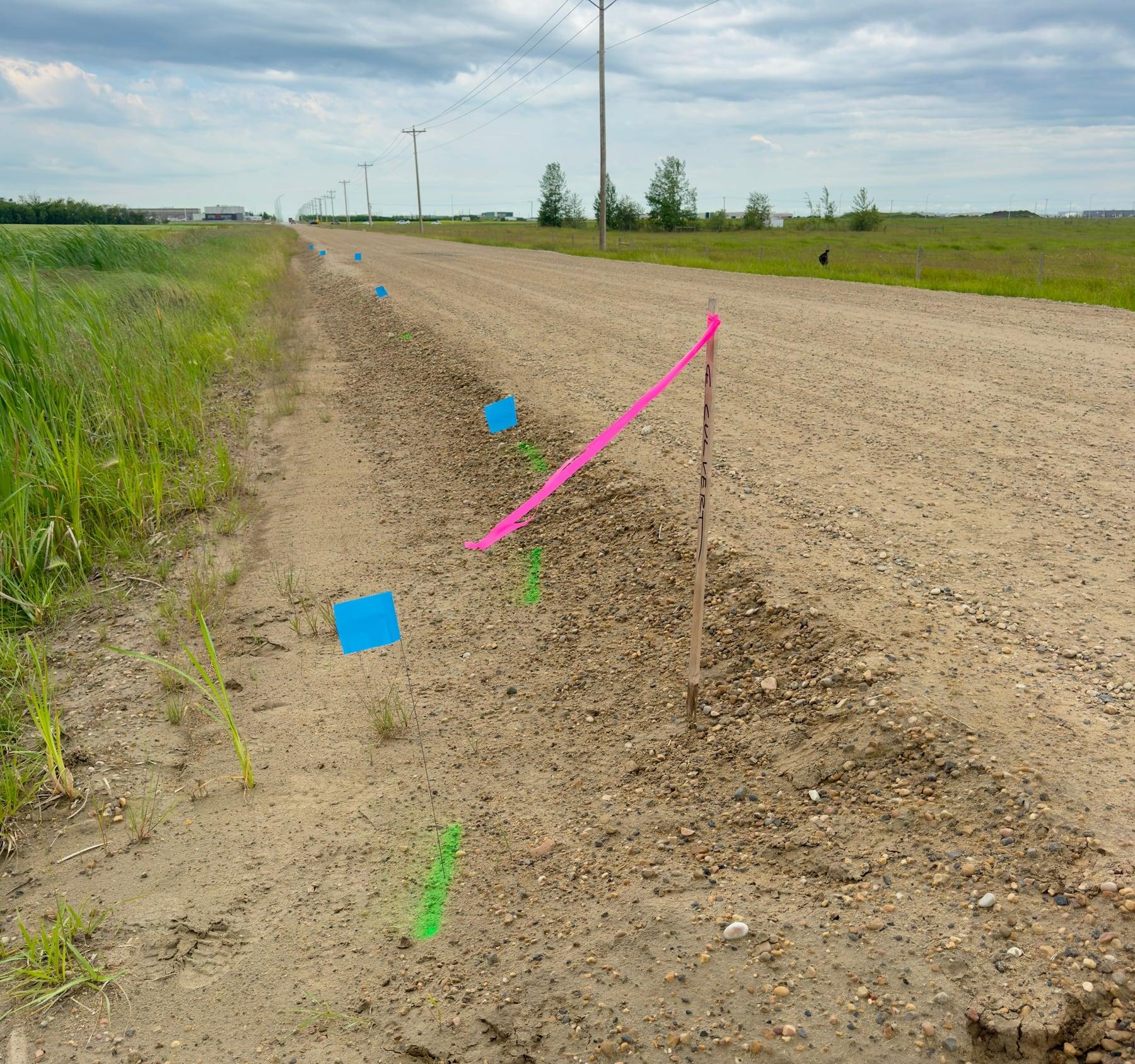
Stakes are rarely set on the actual line of the work, because the excavation would take them out. They are set back a known distance instead. A stake marked with a 3.0 offset to a footing edge means the edge of the footing is 3.0 m from the hub, measured square to the line. The stake should say what the offset is to: centreline, face of wall, edge of footing, back of curb. Face of wall and centreline of wall are not the same thing, and a wrong guess is half a wall thickness out.
The direction is toward the work. Where that could be unclear, two stakes are set on the same line so you can string through them, or an arrow is drawn on the lath. The offsets used for each trade are agreed before construction layout starts.
What do C 0.45 and F 0.20 mean on a stake?
C is cut and F is fill. "C 0.45" means design grade is 0.45 m below the reference point, so you cut. "F 0.20" means design grade is 0.20 m above the reference point, so you fill. Metric stakes are in metres unless they say otherwise.
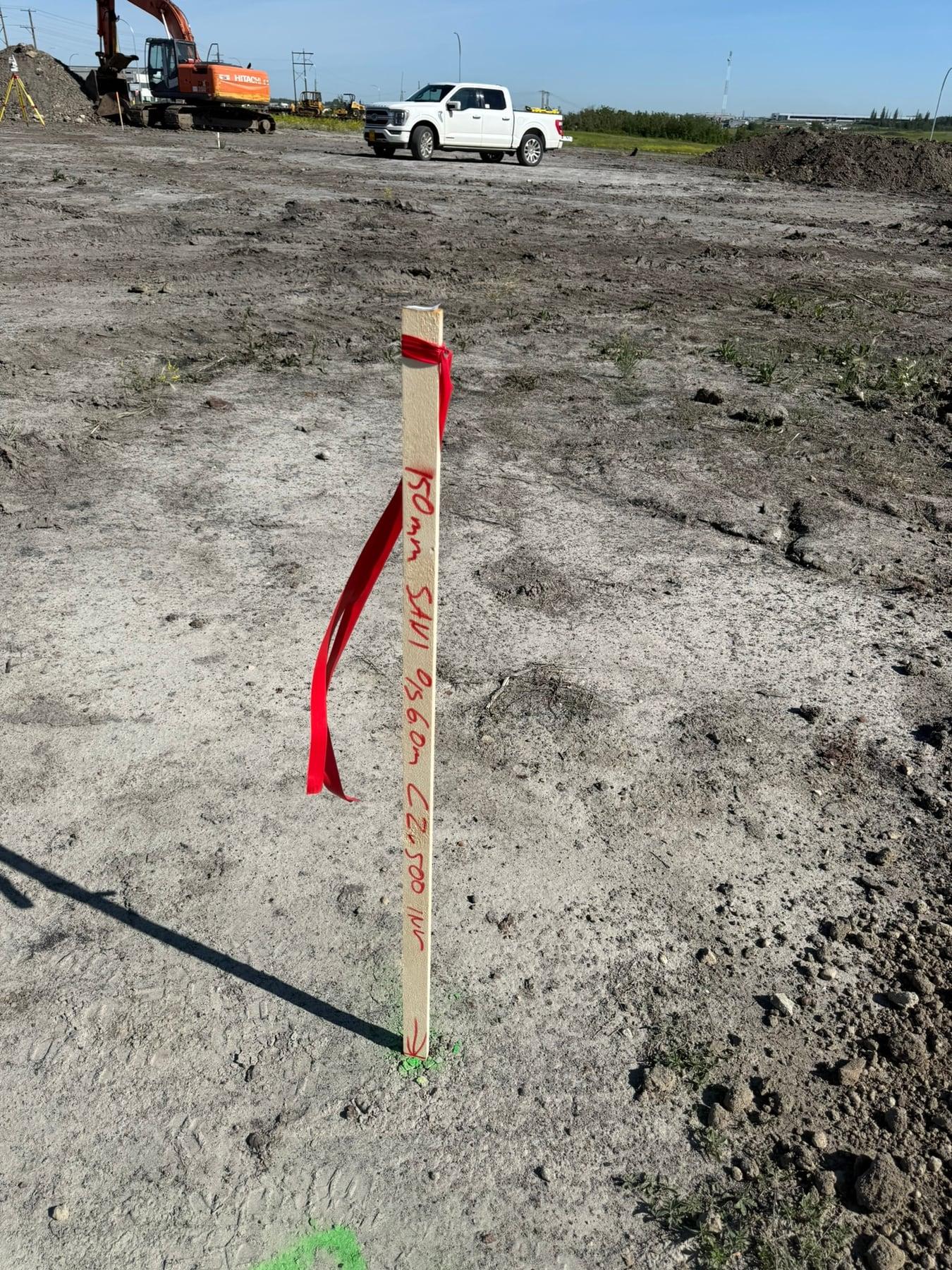
Two questions matter every time. First, measured from where? Usually the top of the hub, sometimes a line on the lath or the ground at the stake. Second, to what? Finished grade, subgrade, top of curb, pipe invert and underside of footing are all different elevations at the same spot. A stake that reads C 1.85 INV is a cut of 1.85 m from the hub to the pipe invert, not to the trench bottom. Allow for pipe wall and bedding yourself, or ask for the stakes to be marked to trench bottom.
What is a station?
On roads, pipelines and utility runs, position along the line is given as a station. Station 1+250 is 1,250 m along the alignment from its zero point. Station 0+047.5 is 47.5 m from the start. Stakes are set at regular stations and at the points that matter, such as bends, grade changes, manholes and catch basins. On underground utility layout, the stakes come with a cut sheet listing every station with its offset and cut, so you can check the stake against the paper.
What are the common stake markings?
| Marking | Usual meaning |
|---|---|
| CL | Centreline of the road, pipe, wall or footing named on the stake. |
| O/S 3.0 or 3.0 OS | Offset. The feature is 3.0 m from the hub. |
| C 0.45 | Cut. Design grade is 0.45 m below the reference point. |
| F 0.20 | Fill. Design grade is 0.20 m above the reference point. |
| GRADE or ON GRADE | The reference point is at design grade. |
| 1+250 | Station. 1,250 m along the alignment from its start. |
| INV | Invert, the inside bottom of the pipe. |
| FG and SG | Finished grade and subgrade. |
| TOC, BOC | Top of curb, back of curb. TOC can also mean top of concrete, so check. |
| GL C or C/3 | Gridline C, or the intersection of gridlines C and 3. |
| BM 672.450 | Benchmark, with its elevation in metres. |
| RP | Reference point, set so another point can be re-established. |
These are common usages, not a standard. Each survey company has its own habits. Ask for a short legend or a field sketch on the first visit, and keep it in the site office.
How do you protect survey stakes on site?
- Walk the stakes with the surveyor or look at the field sketch before equipment moves in.
- Tell operators where the hubs are. The lath is there to be seen, and the hub beside it is what matters.
- Keep stockpiles, sea cans and parked equipment off control points and benchmarks.
- Ask for offsets large enough to survive the excavation, and for a second reference point on work that will take a while.
- Do not pull a stake and put it back. A hub that has been moved, bent or driven deeper is no longer a measurement.
What should you do if a stake looks wrong?
Check it against something independent before you build from it. Tape between two stakes and compare to the drawing dimension. Compare the cut on the stake to the cut sheet. Shoot a grade from a second benchmark. If a stake leans, has tire tracks beside it, or disagrees with its neighbours, treat it as disturbed and call. Resetting a few stakes costs far less than removing concrete. In winter, frost can lift hubs as well, which is covered in winter construction surveying in Alberta.
If you need stakes set or reset on your site, phone (587) 714-2362 or request a crew with the quote form.